




Fuel consumption label
All vehicles on this website must display a label on the front windscreen when purchased new. The label indicates the vehicle’s fuel or energy consumption, and comes from the same data source as this website.
The label is designed to you make informed choices about the environmental impact of new cars and the cost of running a particular vehicle.
Australian Design Rules (ADRs) for Labelling
All vehicles are tested under standardised, carefully controlled conditions in specialised vehicle emission laboratories. To ensure the quality and consistency of test results, laboratories and their facilities are subject to audit by the Australian Government. The test procedure that provides the values on labels, and on this website, is specified by the ADRs for fuel and energy consumption labelling. These ADRs also outline the design requirements for these labels.
Australian Design Rule 81/02 – Fuel Consumption Labelling for Light Vehicles
Vehicle Standard (Australian Design Rule 81/02 - Fuel Consumption Labelling for Light Vehicles) 2008, came into force for new vehicles from 1 April 2009. The Standard requires testing of vehicles to a laboratory test procedure that is known as the New European Drive Cycle, or NEDC.
Last updated in 1997, the NEDC test procedure is defined by the United Nations Economic Commission for Europe (UNECE) Regulation 101 and was designed to measure emissions and fuel consumption from passenger vehicles (excluding light commercial vehicles). There are phases to these tests that are designed to capture varying environments that result in different emissions outcomes.
- Urban Driving Cycle (UDC) reflects driving in built up cities, such as London or Paris. Driving speeds are more restricted with lower vehicle loads.
- Extra Urban Driving Cycle (EUDC) permits higher speeds (to a maximum of 120 km/h) and a more robust simulated driving experience.
The tests themselves consist of a standardised process whereby the ignition is turned off, consumers electronics are disabled, day lights are activated and tyres are set to a specified pressure. Additionally, the tests including brake and gear shift assessments, wheel alignments, alignment with a standard reference fuel and oil. Lastly, it must be verified that the vehicle has travelled at least 3000 km to reflect an element of real world performance.
From both cycles a combined fuel consumption figure is derived. The combined figure and results from both UDC and EUDC test cycles are used for vehicle labelling in accordance with ADR 81/02.
Vehicles complying with ADR 81/02 will display a label with 3 fuel consumption values – for ‘urban’ (low speed), ‘extra-urban’ (higher speed) and ‘combined’, which includes both. It’s important to consider each of these 3 values because the current fuel consumption label only displays the ‘combined’ value, when there can often be quite a range between the values.
For pure electric and externally chargeable (‘plug-in’) hybrid electric vehicles, ADR 81/02 requires an energy consumption label. This label shows the vehicles energy consumption in Watt hours per kilometre (wh/km), expected range when fully charged, fuel consumption in litres/100 kilometres and CO2 emissions in grams per kilometre (g/km).
Illustration of a Fuel Consumption Label, as mandated by ADR 81/02

Illustration of an Energy Consumption Label, as mandated by ADR 81/02

Most vehicles have much higher fuel consumption on the ‘urban’ part of the test cycle, which features a low average speed (19 km/h), substantial idle periods (30%) and frequent stop/start events. For drivers who spend a lot of time in city traffic conditions, this figure will provide a better indication of fuel consumption than the combined result.
In contrast, the ‘extra urban’ component has a relatively high average speed (63 km/h) and a peak speed of 120 kilometres per hour (km/h). It’s not a typical ‘highway’ cycle as it does not maintain a relatively constant speed over an extended period of time, but it is more likely to approximate fuel consumption in freeway or highway driving.
Since the inception of the NEDC, technologies have advanced significantly. Both hybrid and electric vehicles have become more common alongside a series of new measures designed reduce fuel consumption. These advances have led to the introduction of WLTP testing.
Australian Design Rule 81/03 – Energy Consumption Labelling for Light Vehicles
Vehicle Standard (Australian Design Rule 81/03 – Energy Consumption Labelling for Light Vehicles) 2025, comes into force for new vehicles from 1 July 2026 for new vehicle models, and will apply to all applicable vehicles by 1 July 2028. The Standard requires testing of vehicles to a laboratory test procedure that is known as the Worldwide harmonised Light vehicle Test Procedure, or WLTP.
The WLTP was introduced to replace the NEDC procedure through UN Regulation 154, and relies on data to better reflect real world operational conditions. While there are additional real-world considerations, there are other baseline similarities between NEDC and WLTP testing, namely both are laboratory-based procedures. However, there are substantive differences between the two. These include:
- Fuel consumption categories Urban, Extra Urban and Combined associated with NEDC are replaced with Low, Medium, High, Extra High, and Combined.
- CO2 values for individual vehicles that consider optional equipment fittings.
- Allowances for more realistic acceleration and deacceleration dynamics to reflect more accurate driver behaviour
- A more focused vehicle configuration during testing with longer running periods and distances covered
- Higher maximum and average speeds are reached during testing
- Hybrid vehicles are tested with both a charged and depleted battery to accurately evaluate on road emissions
- Enables best and worst-case values on consumer information
These advances in testing aim to provide higher levels of accuracy and transparency for consumers when making choices about vehicle acquisitions. As the new lab tests do not enable an equivalent ‘urban’ and ‘extra-urban’ figure to be produced, new petrol, diesel and non-plug-in hybrid models will not be able to provide this information. With the adoption of WLTP testing in Australia, changes have been made to vehicle efficiency labelling, to reflect and highlight the comparative values of interest to consumers.
Illustration of an Energy Consumption Label for vehicles with CO2 emissions less than or equal to 50g/km, as mandated by ADR 81/03
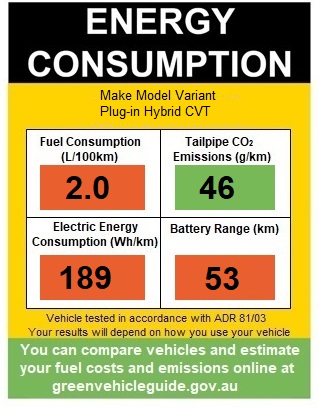
Illustration of an Energy Consumption Label for vehicles with CO2 emissions more than or equal to 50g/km, as mandated by ADR 81/03

Understanding Emissions
To help consumers understand the difference between vehicles certified to differing test procedures, the Green Vehicle Guide has introduced a new field, ‘Test Cycle’, to display this specification where it is known.
While the label alerts consumers of potential CO2 emissions from recharging, it does not provide detail on these emissions, since this will depend on how the electricity is generated. You can use this website to estimate a vehicle's recharge (fuel lifecycle) emissions.